What drives the cost of a new driveway?
| Cost driver | Why it matters |
|---|---|
| Area | More square metres means more material, labour and base |
| Finish | Plain concrete, exposed aggregate, asphalt, pavers and gravel differ a lot in cost |
| Removing the old driveway | Breaking out, loading and carting old concrete or asphalt |
| Excavation depth | Soft or clay ground needs digging deeper to fit a thicker base |
| Basecourse | Compacted aggregate base (such as GAP40 or GAP65) is the driveway's real foundation |
| Thickness and reinforcing | Heavier vehicles need a thicker slab and steel reinforcing |
| Drainage | Falls, channel drains and sumps connected to a lawful stormwater outlet |
| Slope | Steep driveways need more care with grip, falls and drainage |
| Access | Concrete trucks, pumps and machines have to reach the work |
| Vehicle crossing | The section over the berm and footpath needs approval and must meet Council's standard |
| Extras | Edging, retaining, steps, garden reinstatement, lighting |
Driveway finishes compared
| Finish | Typical up-front cost | Maintenance | Good to know |
|---|---|---|---|
| Plain concrete | Lower to mid | Low | Needs proper control joints and reinforcing to manage cracking |
| Exposed aggregate | Mid to higher | Low; optional sealing | Decorative, good grip, hides marks well |
| Coloured or stamped concrete | Mid to higher | Resealing every few years keeps the colour | Patterns can be slippery when wet without the right sealer |
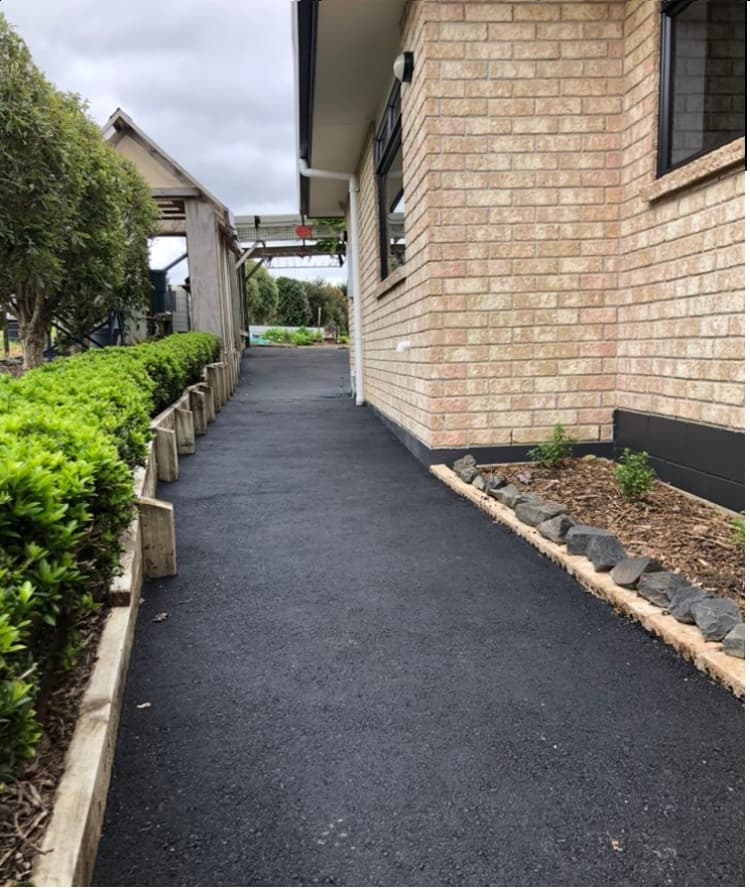
| Asphalt (hotmix) | Often lower to mid on larger areas | Low; easy to patch | Needs a well-compacted base and edges to stop fretting |
| Chip seal | Usually the lowest sealed option | Resealing over time | Suits long rural driveways; loose chip at first |
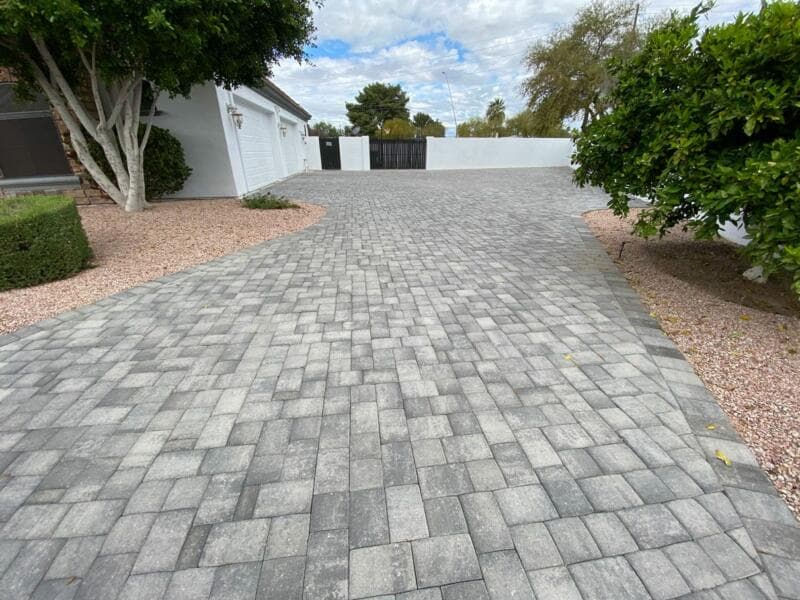
| Pavers | Higher | Relevelling, weeds in joints | Can be lifted for access to services; permeable options help stormwater |
| Gravel | Lowest | Topping up and raking | Migrates onto lawns and the road on slopes |
The right finish depends on the slope, the vehicles using it, your budget and the look you want. For more on finishes, read our driveway types comparison.
Why ground preparation decides how long a driveway lasts
Most driveway failures start underneath. Auckland's clay soils swell and shrink with moisture, and soft spots settle under car wheels. A durable driveway has:
- topsoil and soft material dug out;
- a firm subgrade, with geotextile where the ground is weak;
- a compacted aggregate base to the right depth, laid in layers;
- the right slab thickness and reinforcing for the vehicles using it;
- control joints in concrete, so cracking happens where it's planned.
When two driveway quotes differ a lot, the base depth and thickness are often why.
Drainage and stormwater
A driveway is a big hard surface, and the water has to go somewhere lawful:
- fall away from the house and the garage door;
- channel drains or sumps at low points, connected to the stormwater system or approved soakage;
- never onto a neighbour's property.
Residential zones in the Auckland Unitary Plan also limit how much of a site can be covered in hard surfaces, so a large new driveway can trigger rules. Permeable pavers or gravel can help. On soakage properties, check the soak hole can take the extra water. Our soak hole guide explains why.
What about the vehicle crossing?
The vehicle crossing is the part of the driveway that crosses the berm and footpath to the road. It's on public land, so it needs approval and has to be built to Council's standard. From 1 October 2026, works on the road in Auckland are approved by Auckland Council rather than Auckland Transport. Allow time for the application in your programme. A new crossing, a widened one, or one damaged by construction traffic is a separate line in a good quote.
Do you need consent for a new driveway?
A driveway on private land usually doesn't need building consent on its own. But the work around it can need approval:
- the vehicle crossing (approval to work on the road);
- retaining walls beside or below it (a driveway above a wall is a surcharge, so see the retaining wall consent guide);
- new drainage connections;
- earthworks, if the area or volume exceeds the Unitary Plan limits;
- impervious area rules in residential zones.
How long does a new driveway take?
It depends on the size, the finish, the ground and the weather. The usual sequence is: remove the old surface, excavate, lay and compact the base, install drainage, then pour or lay the finish. Concrete needs curing time before you drive on it, so your contractor will tell you when it's ready for cars.
How to compare driveway quotes
Check that each quote states:
- the area in m², and what's included at the edges;
- slab thickness or asphalt depth, and the base depth and material;
- reinforcing (mesh or bars) and joints for concrete;
- drainage: channels, sumps and where they connect;
- removal and disposal of the old driveway;
- whether the vehicle crossing is included, and who applies for approval.
Ambient Civil builds concrete, exposed aggregate, asphalt and paved driveways across Auckland, base and drainage included. Book a free measure and quote.
Sources and further reading
General information only. Every site is different: consent, engineering and safety requirements depend on your property, so check with Auckland Council or a qualified professional, or ask us for a free site visit.
About this guide. Written by the Ambient Civil team: 22 in-house crew and 20+ years of civil construction, demolition and earthworks across Auckland. Rules and licence requirements are summarised from the official sources listed above and were checked on . Rules change, so confirm your property's position with Auckland Council or a qualified professional.
All guides->