Asphalt or concrete driveway for your Auckland home? This guide compares cost, durability, maintenance, and what works best on Auckland
Published July 2025 | Ambient Civil Team | 7 min read
Choosing between asphalt and concrete for your driveway is one of the most common questions homeowners ask before a driveway project in Auckland. The honest answer is that both materials can perform well but only if the sub-base is done correctly. This guide explains the real differences between asphalt and concrete driveways, what they each cost in New Zealand, how they perform on Auckland's heavy clay soils, and which option makes most sense for your situation.
The Sub-Base Reality: What Most People Miss
Before comparing surface materials, let's talk about the most important part of any driveway the sub-base. This is what the asphalt or concrete sits on, and it's what separates a driveway that lasts 20 years from one that cracks and subsides in three.
Auckland's Waitemata clay is highly expansive it swells significantly when wet and shrinks when dry. This ground movement puts enormous stress on any rigid surface above it. Without a proper sub-base (typically 150–200 mm of compacted AP40 or AP65 aggregate), even a well-poured concrete driveway will crack and move within a few years.
Any contractor quoting a driveway without mentioning the sub-base should raise a red flag. At Ambient Civil, the sub-base is always specified and compacted before any surface is laid.
Concrete Driveways
Pros
- Longevity: A well-constructed concrete driveway in Auckland should last 25–40 years with minimal maintenance.
- Strength: Concrete handles point loads (vehicles parked, heavy delivery trucks) better than asphalt at equivalent thicknesses.
- Reflectivity: Light-coloured concrete reflects heat important in Auckland's humid summers for garages and covered areas.
- Low maintenance: No sealing required. The main maintenance is cleaning.
- Aesthetics: Can be coloured, stamped, exposed aggregate, broom-finished or brushed to suit architectural styles.
Cons
- Higher upfront cost: Concrete is typically 20–40% more expensive per square metre than asphalt in New Zealand.
- Slower to complete: Concrete needs 7–14 days to cure before vehicle use. Asphalt can typically be driven on within 24–48 hours.
- Crack repair visibility: Concrete cracks are more visible and harder to repair inconspicuously than asphalt.
- Oil staining: Oil stains penetrate concrete and can be hard to remove without specialist cleaners.
Cost in Auckland (2025)
Residential concrete driveways in Auckland typically cost $120–$200 per square metre installed, including sub-base preparation, reinforcing mesh, concrete supply and finishing. Decorative finishes (exposed aggregate, coloured) add $20–$50 per m². A standard 50 m² driveway costs approximately $6,000–$10,000 complete.
Asphalt Driveways
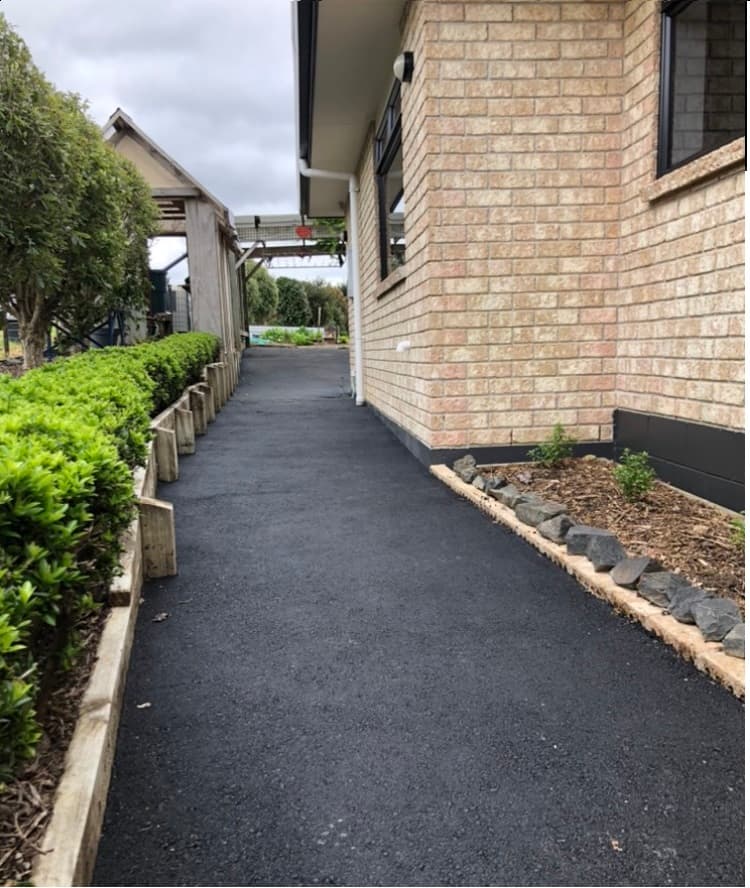
- Lower initial cost: Asphalt is generally less expensive per square metre than concrete.
- Flexibility: Asphalt is a flexible pavement that accommodates slight ground movement better than rigid concrete. On unstable soils, this can mean fewer visible cracks.
- Quick turnaround: Asphalt can be laid and driven on in 24–48 hours.
- Easy patching: Asphalt repairs blend in more easily than concrete patches.
- Warm in winter: Dark asphalt absorbs heat less frost in cooler south-facing Auckland driveways.
- Requires sealing: Asphalt needs to be sealed every 3–5 years to prevent UV degradation, water ingress and oxidation.
- Heat sensitivity: In Auckland's summer heat, asphalt can soften and track under vehicle tyres, particularly around turning areas and under parked vehicles with narrow tyres.
- Shorter lifespan without maintenance: An unsealed, maintained asphalt driveway may last only 10–15 years. With proper sealing and maintenance, 20–25 years is achievable.
- Not suitable for steep driveways: Auckland's many steep residential sections can cause issues with asphalt during hot weather vehicle tyres can dig in on uphills.
Residential asphalt driveways in Auckland typically cost $80–$140 per square metre installed, including sub-base, prime coat and asphalt surface course. A standard 50 m² driveway costs approximately $4,000–$7,000 complete.
Did You Know?
In Auckland, steep driveways (over 12.5% gradient) accessing more than one dwelling require compliance with Auckland Transport's access and manoeuvring design guides. For driveways over 25% gradient, specific surface treatment requirements apply. Concrete is generally preferred over asphalt for driveways above 15% gradient in Auckland due to better grip and heat resistance.
Which Should You Choose?
Our recommendation for most Auckland residential driveways: Concrete, because the long-term maintenance savings and durability outweigh the higher upfront cost especially for sloped Auckland sections. Asphalt makes sense for flat sites, large areas where cost matters, and temporary or industrial access.
Get a Driveway Quote from Ambient Civil
Ambient Civil installs concrete and asphalt driveways across Auckland with the correct sub-base for local soil conditions. Free, no-obligation quotes available.
Get a free quote from Auckland's civil driveway experts.