A complete guide to the demolition process in New Zealand from Auckland Council consents and asbestos surveys to demolition day and site clearing. What to expect at each step.
Published August 2025 | Ambient Civil Team | 9 min read
Demolishing a building in New Zealand whether a residential house in Pakuranga or a commercial building in the Auckland CBD involves a defined sequence of steps that most property owners aren't fully aware of before they start. Skip or rush any step and you risk delays, cost overruns, health and safety breaches, or consent complications. This guide walks through every stage of the demolition process in New Zealand, with a focus on Auckland's specific requirements.
Step 1: Check if Demolition is Permitted
Before anything else, check whether demolition of your building requires resource consent in addition to the standard building consent. In Auckland, the key trigger is the Special Character Overlay approximately 8,500 pre-1944 residential properties in inner suburbs like Ponsonby, Grey Lynn, Mt Eden, Parnell and Devonport are subject to this overlay. Demolishing a contributing character building in these areas requires a non-notified or notified resource consent, and Auckland Council is not rubber-stamping these applications.
Other overlay triggers include heritage listing (listed buildings require resource consent regardless of age), the Hauraki Gulf Islands precinct, and certain coastal and ecological areas. Ambient Civil's team checks overlay status at the quoting stage for every demolition project.
Step 2: Asbestos Survey
Under the Health and Safety at Work (Asbestos) Regulations 2016, a refurbishment and demolition (R&D) asbestos survey must be carried out before any structural demolition of a commercial building. For residential properties, while not legally mandated in the same way, WorkSafe NZ strongly recommends (and Ambient Civil requires) a survey before demolition of any pre-1990 Auckland home.
The survey involves sampling suspect materials fibrolite cladding, vinyl floor tiles, textured ceiling coatings, pipe lagging, roof materials and sending samples to an accredited laboratory. Results typically take 2–5 business days. If asbestos is found, a removal plan must be prepared and executed before structural demolition begins.
Step 3: Building Consent Application
A building consent for demolition is required under the Building Act 2004 for any building that required a building consent when originally built. For most residential houses built in Auckland, this means a demolition consent is required.
The application to Auckland Council includes:
- Site plan showing the building to be demolished and adjacent structures
- Evidence of existing building consents (or exemption application if records are unavailable)
- Description of demolition methodology
- Hazardous materials report (from the asbestos survey)
- Confirmation of service disconnections
Auckland Council's target processing time for demolition consents is 20 working days. In practice, straightforward residential demolitions are often processed in 10–15 working days. Heritage or special character applications take longer.
Step 4: Service Disconnections
Before demolition can begin, all utility services must be disconnected at the boundary or capped. This involves:
- Electricity: Vector (for most of Auckland) disconnects the service connection. Allow 2–4 weeks.
- Gas: Contact your gas retailer and Vector Gas or First Gas for disconnection.
- Water: Watercare disconnects the water connection at the boundary toby. Same-day or next-day service possible with advance booking.
- Wastewater: The connection is physically capped as part of the demolition work no separate disconnection usually needed.
- Telecommunications: Chorus, Vodafone, 2degrees remove or cap aerial or underground connections before structure is demolished.
Service disconnections are the most common cause of demolition project delays. We recommend starting this process as soon as the demolition consent is submitted, not after it's received.
Step 5: Asbestos Removal (if required)
If the asbestos survey identified asbestos-containing materials, these must be removed before structural demolition. Class A (friable) asbestos must be removed by a licensed removalist, with WorkSafe NZ notified at least five working days before work begins. Class B (non-friable, bonded) removal of areas over 10 m² must also be notified.
Asbestos removal takes 1–5 days for most residential properties. Air clearance testing confirms the site is safe before structural work proceeds.
Step 6: Soft Strip
Once services are disconnected and asbestos removed, the soft strip begins. This involves removing all salvageable and recyclable materials before structural demolition timber framing, copper and steel, plasterboard, windows and doors, kitchen and bathroom fittings. This reduces the volume of material sent to landfill and is a regulatory requirement for commercial demolitions under the NZGBC's waste minimisation framework.
Step 7: Structural Demolition
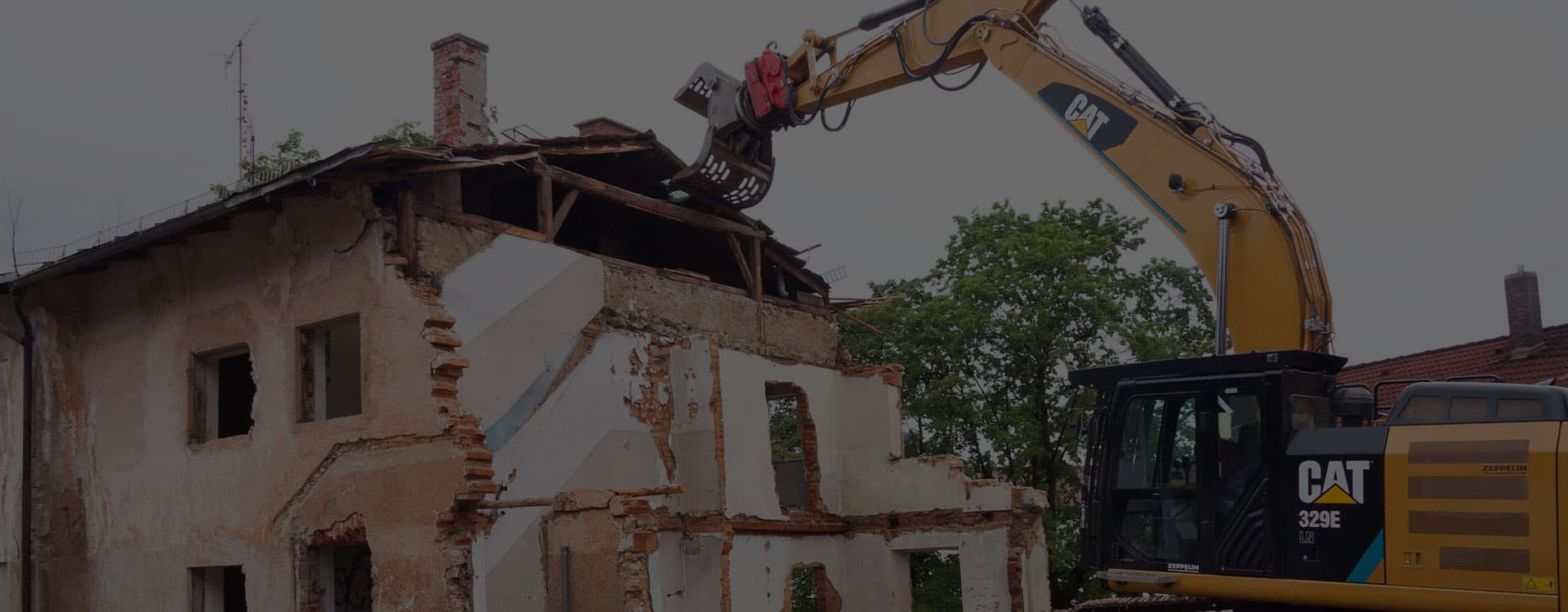
With consents issued, services disconnected, asbestos removed and soft strip complete, structural demolition begins. For a typical Auckland residential house, structural demolition takes 1–3 days using a 5–13 tonne excavator with a hydraulic thumb or jaw attachment. The operator breaks the structure systematically, separating concrete and masonry from timber waste for different disposal streams.
Dust suppression (water spraying) is maintained throughout, and hoarding is in place before demolition begins. Neighbours and Council are notified per the consent conditions.
Step 8: Site Clearing and Waste Disposal
After structural demolition, the site is cleared of all debris. Concrete is crushed on site or taken to a recycling facility. Timber is disposed of or chipped. Metal is sent to scrap dealers. General C&D waste goes to an approved disposal facility with a waste transfer record.
Pile stumps, concrete slabs, paths, drainage connection pits and service connections below ground are removed as part of the site clearing scope. The site is levelled and graded ready for your next project.
Did You Know?
The total timeline from deciding to demolish to having a clear site in Auckland including consent processing, service disconnections and asbestos removal is typically 8–14 weeks for a straightforward residential property. In heritage or special character areas with resource consent requirements, add 4–12 weeks for consent processing. Planning ahead is essential to avoid programme delays on your build project.
How Ambient Civil Manages the Demolition Process
Ambient Civil manages the complete demolition process under a single contract asbestos survey coordination, consent application, service disconnection management, soft strip, structural demolition and site clearing. You deal with one team, one contract, one timeline. We provide written progress updates and notify you as each stage is completed. Our clients tell us the biggest benefit is not having to chase multiple contractors and coordinate between trades.
Planning a Demolition in Auckland?
Contact Ambient Civil for a free quote and timeline estimate. We manage the complete process from consent to clear site.
Get a free, no-obligation demolition quote from Auckland's experts.