When is demolition exempt from building consent?
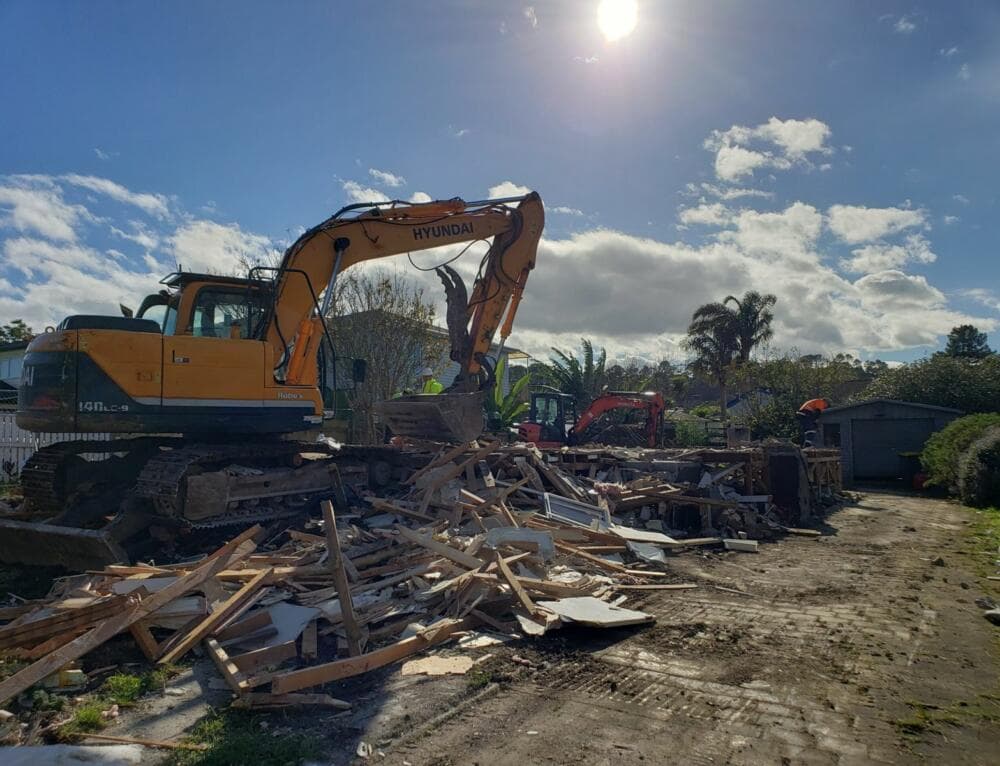
Schedule 1 of the Building Act 2004 lists building work that doesn't need a building consent. Exemption 30 covers the complete demolition of a detached building that is no more than three storeys high. That describes most stand-alone Auckland houses, garages and sheds.
The exemption only covers the building consent. The work still has to be done safely and lawfully, which means:
- identifying and removing asbestos first if the building was built before 2000;
- disconnecting services properly, with water and wastewater connections capped and sealed under Watercare's process;
- keeping the site safe for the public and neighbours.
You don't apply for an exemption. It's your responsibility (and your contractor's) to be sure the work really is exempt, so keep a record: photos, the asbestos survey and clearance, and the disconnection paperwork.
When does demolition need a building consent?
| Situation | Building consent? | Why |
|---|---|---|
| Complete demolition of a detached house, up to three storeys | Usually not | Exemption 30 |
| Complete demolition of a detached garage, shed or sleep-out | Usually not | Exemption 30 |
| Partial demolition (removing part of a house) | Generally yes | The remaining building must still comply with the Building Code |
| Demolishing one unit of an attached building (semi-detached, terrace) | Generally yes | Exemption 30 only covers detached buildings; the shared wall and the neighbour's building are affected |
| Buildings over three storeys | Yes | Outside the exemption |
Some smaller partial works can fall under other Schedule 1 exemptions. If you're unsure, check with Auckland Council or ask us at the site visit.
When do you need resource consent to demolish?
Resource consent is about the Auckland Unitary Plan and the Resource Management Act, not the Building Act. The common triggers are:
- Historic Heritage overlay (D17). Demolishing a scheduled heritage place generally needs resource consent and is assessed strictly.
- Special Character Areas overlay (D18). Demolition in these areas typically needs resource consent, and Council assesses what the building contributes to the area's character.
- Notable trees. Works near a scheduled tree, including the demolition machines and the earthworks after, can need consent.
- Earthworks after demolition. Removing foundations and regrading counts as earthworks under chapter E12; larger areas or volumes, or sensitive locations, can need consent. See the earthworks consent guide.
- Contaminated land. If the site has a HAIL history (a former orchard, fuel tank or workshop, for example), disturbing the soil can trigger the national contaminated soil rules. See the contaminated land guide.
A special character or heritage overlay doesn't automatically mean you can't demolish. It means Council assesses the application, so allow for a planner's report and processing time.
How do you check your own property?
- Search your address on the Auckland Unitary Plan viewer and look for overlays (Historic Heritage, Special Character, notable trees) and controls.
- Order a LIM or check the property file for existing consents, heritage notes and drainage plans.
- Check the build date. If it's before 2000, budget for an asbestos survey. Our asbestos before demolition guide explains what's involved.
- Talk to a planner if an overlay applies. Auckland Council has duty planners, or use your own consultant.
What still applies even when no consent is needed?
| Requirement | Who's involved |
|---|---|
| Asbestos survey and removal (pre-2000 buildings) | Competent surveyor; licensed removalist where required; clearance certificate |
| Water and wastewater disconnection | Watercare approval; connections capped and sealed |
| Power, gas and telecommunications disconnection | Your retailer and network companies |
| Site safety and public protection | The demolition contractor's health and safety plan |
| Trucks and works on the road | Approval for any works in the road corridor |
| Dust, noise and neighbours | Unitary Plan standards; good practice on site |
How Ambient Civil handles demolition consents
At the site visit we check the overlays, the age of the building, the access and the ground. If no consent is needed we say so, and we sequence the asbestos survey, disconnections, removal and demolition. If resource consent is needed we tell you early so the programme reflects it, and we work alongside your planner. Book a free site visit.
Sources and further reading
- Building Performance (MBIE): Demolition of a detached building (Schedule 1, Exemption 30)
- Building Performance (MBIE): Building work that doesn't need a building consent
- Auckland Unitary Plan (Operative in part)
- WorkSafe: Asbestos – demolition and refurbishment
- Watercare: Change a connection (disconnecting water and wastewater)
General information only. Every site is different: consent, engineering and safety requirements depend on your property, so check with Auckland Council or a qualified professional, or ask us for a free site visit.
About this guide. Written by the Ambient Civil team: 22 in-house crew and 20+ years of civil construction, demolition and earthworks across Auckland. Rules and licence requirements are summarised from the official sources listed above and were checked on . Rules change, so confirm your property's position with Auckland Council or a qualified professional.
All guides->