Why do pre-2000 buildings need an asbestos check?
Asbestos was widely used in New Zealand building products until the late 1990s. WorkSafe's guidance is that a business must identify asbestos before demolition or refurbishment if the structure was built before 2000, if asbestos has already been identified, or if it's likely to be present. Newer buildings carry lower risk, but the date alone doesn't settle it.
Common places it turns up in Auckland houses:
- fibre-cement cladding, soffits and eaves linings;
- fibre-cement roofing and gutters;
- textured ceilings and some wall linings;
- vinyl floor coverings and their backing, and some adhesives;
- insulation around old pipes, boilers and flues;
- fire surrounds and heater backings.
What kind of asbestos survey do you need?
For demolition you need a demolition survey, sometimes called a refurbishment or demolition survey. It's intrusive: the surveyor looks inside walls, ceilings, floors and roof spaces, because the whole building is about to be disturbed. Suspect materials are sampled and analysed by a laboratory. The survey report lists where asbestos is, what type it is, its condition and roughly how much there is, and that's what the removal is priced from.
A management survey, used for an occupied building, isn't enough for demolition because it doesn't look behind linings.
Friable and non-friable asbestos: what's the difference?
| Non-friable (bonded) | Friable | |
|---|---|---|
| What it is | Asbestos fibres bound in a solid material such as cement | Material that is powdery, or can be crumbled to powder by hand pressure |
| Typical examples | Fibre-cement sheet cladding, soffits, roofing | Pipe lagging, sprayed insulation, badly damaged or weathered sheet |
| Risk when disturbed | Lower while intact; rises when broken, cut or sanded | High: fibres release easily |
| Licence needed to remove | Class B or Class A for more than 10 m² | Class A for any amount |
Who can remove asbestos before demolition?
| Asbestos work | Who can do it |
|---|---|
| Up to 10 m² of non-friable asbestos, counted across the whole project | A competent person, without a removal licence (controls still apply) |
| More than 10 m² of non-friable asbestos | A licensed removalist with a Class B or Class A licence |
| Any amount of friable asbestos | A Class A licensed removalist |
The 10 m² limit is cumulative across the whole project. Dividing a job into smaller areas to stay under 10 m² isn't allowed.
What happens during licensed asbestos removal?
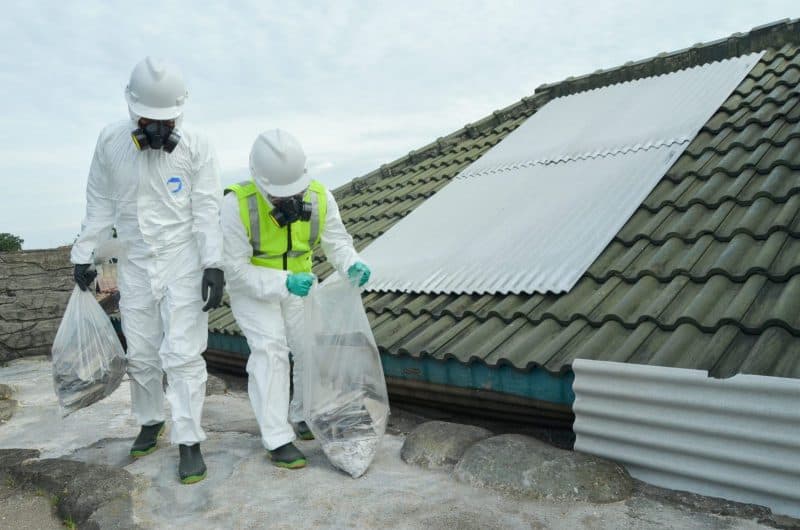
- Planning. The licensed removalist prepares an asbestos removal control plan and notifies WorkSafe before starting.
- Set-up. The work area is isolated with barriers and signs. Friable removal is done inside an enclosure with controls to stop fibres escaping.
- Removal. Materials are wetted and removed whole where possible, never broken up or cut with power tools.
- Decontamination and packaging. Workers, tools and the area are decontaminated, and waste is wrapped, labelled and transported to a facility that accepts asbestos.
- Clearance. For Class A work, a licensed asbestos assessor carries out a clearance inspection with air monitoring and issues a clearance certificate. For Class B work, clearance can be done by an independent competent person.
Only after clearance does demolition start.
What if asbestos is found during demolition?
If material that might be asbestos turns up and wasn't in the survey, work in that area stops. The area is isolated, the material is sampled, and if it's asbestos it's removed under the right controls before demolition carries on. A thorough survey up front makes surprises rare, which is why we insist on one.
Can a homeowner remove asbestos themselves?
The 2016 regulations place duties on businesses (PCBUs). A homeowner working on their own home isn't covered in the same way, but the health risk is identical, and asbestos waste still has to go to a facility that accepts it. For anything beyond a small amount of intact sheet, and for any friable material, use a licensed removalist. It's also simpler when the same contractor handles removal and demolition: one programme and one point of contact.
The paperwork you should end up with
- The demolition asbestos survey with laboratory results.
- The asbestos removal control plan (for licensed work).
- The clearance certificate.
- Disposal records showing where the waste went.
Keep them. They're your evidence that the demolition was done properly, and buyers, insurers and Council may ask for them.
Ambient Civil holds WorkSafe Class A and Class B asbestos removal licences and runs removal and demolition as one programme. Get a free site visit, or read the asbestos removal cost guide.
Sources and further reading
General information only. Every site is different: consent, engineering and safety requirements depend on your property, so check with Auckland Council or a qualified professional, or ask us for a free site visit.
About this guide. Written by the Ambient Civil team: 22 in-house crew and 20+ years of civil construction, demolition and earthworks across Auckland. Rules and licence requirements are summarised from the official sources listed above and were checked on . Rules change, so confirm your property's position with Auckland Council or a qualified professional.
All guides->